







Workplace Fall Hazard Survey
Fall Protection Program Fundamentals – Part 1
What would you think about a doctor who prescribes radical surgery, without so much as a routine check-up, after you mention a stomach ache over the phone? Sounds negligent, doesn’t it? It is.
Time must be taken to fully diagnose the basic ailment. Additional time must be taken to understand how the ailment affects the specific patient. Then more time must be taken to understand which treatment and medication are best for this specific ailment, in this specific person’s body, in the environment in which they live. One size does not fit all. A hurried, one-size-fits-all approach has the possibility to do serious damage.
The same principle is true when considering fall hazards in the workplace. A competent fall protection practitioner won’t prescribe fall protection solutions without specific details. He/she won’t dole out a part number for a ladder and ladder safety system, and order it attached to a structure, without specific information about the structure, work, environment, etc. A one-size-fits-all approach to fall protection can make the situation worse and has the possibility to do serious damage, just as it would in the medical world.
A competent fall protection practitioner will respond to a request for a fall protection prescription with: “When can I visit the site to perform a fall hazard survey?” The fall hazard survey is the first step in diagnosing the hazard so that the prescribed treatment will address the problem without creating unforeseen negative, even life threatening, side effects.
The pictures below show what can result when the one-size-fits-all shortcut approach to fall protection is used. The prescribed ladder safety system has eliminated the possible entry points though the side of the tower, forcing the climber to climb the entire tower to enter from the top opening, only to have to climb back down to the work platform without the aid of a ladder or ladder safety system. The situation is arguably more hazardous than if no fall protection had been prescribed at all! If a fall protection practitioner had visited this site, they would have realized that this solution was not acceptable in this situation, for this work task. An adjustment to the system, or another approach, could have been prescribed.
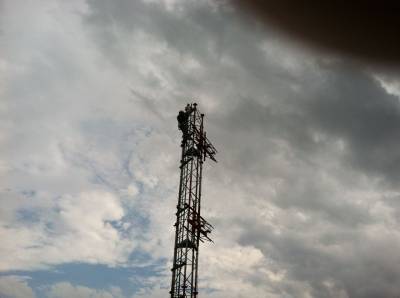
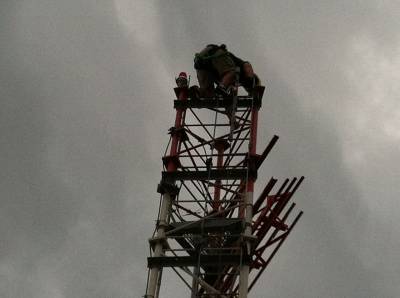
Medical doctors have defined methodical protocols to ensure that they gather a core set of information before prescribing medication and treatment. These protocols are roughly the same regardless of which doctor you see in any part of the country, or even world. The same is true, or should be true, when diagnosing fall protection hazards.
American National Standard ANSI/ASSE Z359.2-2007 Minimum Requirements for a Comprehensive Managed Fall Protection Program is the document that contains the protocol for conducting a fall hazard survey. FAA employees can, PASS representatives should, download a copy when signed into the agency intranet: https://ksn2.faa.gov/ajw/es4/nes/res/ihsaccess.aspx .
A written fall hazard survey report should be available for every workplace where any type of fall hazard exists. In general, if work is performed more than four feet from the ground, platform or deck, a fall hazard exists that should be addressed in a fall hazard survey report.
The fall hazard report must be site and task specific, comprising four fundamental elements:
- A list of all fall hazards through 100% of the path of travel while performing all predictable maintenance tasks, not simply scheduled recurring preventative maintenance.
- One or more methods identified for elimination or control of each hazard.
- Drawings showing the location of hazards and distances to obstructions within each fall path.
- Environmental factors that may effect the installation, use, inspection, maintenance and dismantling of a fall protection system, e.g., extreme temperatures, ice, snow, proximity to weapons firing ranges and hunting areas, unstable and uneven walking surfaces, etc.
Get with your PASS workplace representative to formally request a copy of the the written fall hazard survey report for your workplace from the workplace supervisor if a fall hazard exists. A tower usually comes to mind when thinking about fall hazards associated within the NAS. The range of fall hazards in our workplace are much further ranging than just towers. Consider: access to and work on rooftops; loading dock pits; access to, and work on, a mezzanine; working from a ladder that can’t be opened or positioned for a proper working angle; climbing equipment to access a fill port or maintenance hatch; no practicable method of carrying tools and equipment to a roof, platform, or when working from a ladder, etc.
The report should be immediately available. Contact the National ATO PASS Representative, your PASS Regional Safety Representative, or PASS Regional Vice President if a written fall hazard survey report is not provided within a couple of days, if not hours. Completing the fall protection checklist provided as an appendix to JO 3900.63 does not constitute a fall hazard survey, nor a fall hazard survey report. Additional information, including a grievance template, is provided in the PASS Occupational Safety and Health Bulletin: Fall Protection – Fall Hazard survey.
The next installment of the Fall Protection Program Fundamentals series will address site specific fall protection procedures that are based on the fall hazard survey report.