







There are two fundamental purposes for emergency lighting: (1) safely complete/terminate tasks when primary task lighting is lost; and (2) egress from the workplace during an emergency. This article addresses the first case, emergency task lighting. Emergency task lighting is addressed in several places in OSHA regulations and industry consensus standards.
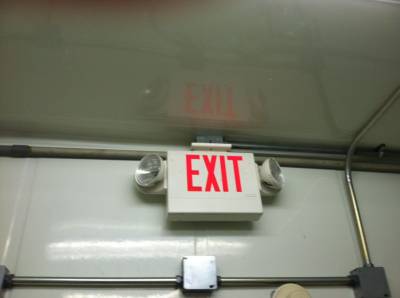 OSHA prohibits workers from entering areas where they may come into contact with energized electrical equipment without adequate task lighting [29 CFR 1910.333(c)(4)]. Facility task lighting can be lost while equipment is still energized if commercial power is interrupted and the NAS equipment remains operational on battery supplied power. Additionally, the lighting circuit itself can be lost, while all or some NAS equipment remains operational on other power circuits. Adequate lighting is also required while specialists verify an electrically safe condition when troubleshooting to confirm that a facility power outage is indeed due to a loss of commercial power rather than some other failure of the service entrance equipment.
National Fire Protection Association (NFPA) 110, Standard for Emergency and Standby Power Systems, 2013 Edition, Article 7.3, requires that battery-powered emergency lighting be provided in places like engine generator rooms, specifically for task lighting, regardless of any requirement for lighting of exits. Likewise NFPA 111, Standard on Stored Electrical Energy Emergency and Standby Power Systems, 2013 Edition, Article 7.2.3.2, requires emergency lighting in rooms where stored power battery system equipment is installed (e.g., PCS, UPS). [See Origin of Electrical and Fire Protection Standards for information about the NFPA its standards.] These standards seek to prevent a situation where lighting is lost while working on the source of backup power itself.
Unfortunately, emergency lighting has become something to be avoided in many places around the NAS. The reason most often heard for avoiding emergency lighting is that it is labor intensive and costly to maintain. This assertion is not without basis. Unfortunately, the agency has decided not to centrally source and stock a common maintainable unit. Replacement parts can be extremely difficult to find for some units. Moreover, maintaining emergency lighting can seem pointless. Where the lighting is needed most, emergencies do not frequently occur. However, in the rare instances when it is needed, it can be a matter of life and death for someone engaged in what would otherwise be low-risk work.
The American people through the United States Congress, and the international community through industry consensus standards making bodies, believe that our lives are important enough to invest their time and resources to implement and maintain adequate emergency task lighting. Additionally, OSHA and NFPA standards arise from documented workplace mishaps. These standards give us the opportunity to employ our uniquely human intelligence to learn from, and avoid, the mistakes of others.
Please contact your PASS regional safety representative if you are aware of any location where adequate emergency lighting is not provided, especially in rooms where an engine generator or stored energy power system is located.