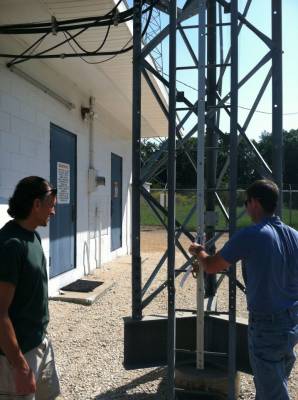







Ladder safety systems (LSS) are provided on most of the towers used to elevate and support air-to-ground radio, microwave datalink, and instrument landing system (ILS) glide slope (GS) antennas. These towers can range from under twenty to over hundreds of feet in height. A continuous rail is attached to the center of the ladder running from ground level to the maximum work height. Sometimes, notches or holes, are provided at short intervals along the rail. The climber attaches their body harness to the safety rail or cable using a compatible attaching device, or sleeve. The rail and sleeve are designed to work together so that the sleeve can easily slide up along the rail or cable, but stop if the sleeve descends unexpectedly.
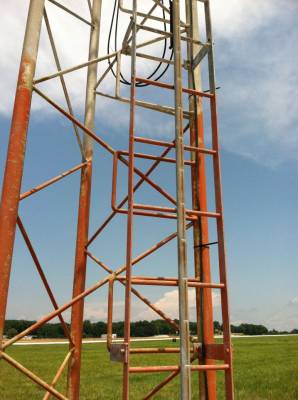
Notched tubular rails, like the one shown to the left, have proven to malfunction and are prohibited in the FAA. Unfortunately, this information has not reached all facilities. These LSS have been recently found in use on both GS and air-to-ground radio antenna towers.
Any existing LSS with a notched tubular center rail should be immediately removed from service. If it is not feasible to remove the rail, a sign should be prominently placed so that anyone approaching the tower is warned to not use the existing LSS. It is also important to inform the assigned Competent Person so that the facility fall protection procedures can be updated so that they do not include the use of the LSS.
The Competent Person should immediately perform an inspection of the facility using the checklist provided in the Fall Protection Order JO 3900.63. It is also important that the details of the facility’s tower infrastructure is accurately reflected in the unmanned infrastructure database, accessible from behind the agency firewall: http://uisafp.faa.gov/.
Notify your PASS Regional Safety Representative immediately if you find a notched tubular LSS in use. That phone call could very well save a life.